
I remember the sterile flash of gunfire, the familiar cadence of war that has been my home for years. Then, in the summer of 2026, the horizon of my battlefield shifted, not with a bang, but with the melancholic chime of a forgotten piano. Call of Duty: Mobile, the titan of mobile shooters developed by TiMi Studios, did not announce another gritty military operation. Instead, it whispered of androids and existential sorrow, heralding a crossover with Yoko Taro's masterpiece, NieR: Automata, beginning May 30. This was not a mere content update; it felt like a ghost from a different world had brushed against the steel and smoke of my own, leaving traces of cosmic dust and philosophical yearning in its wake.
The announcement was a revelation, a piece of found poetry in a data stream. Activision promised we would take control of the YorHa Unit, trading our standard-issue dog tags for the sleek, black visor of an android soldier, tasked with fighting against the haunting Machine Lifeforms. This wasn't just a skin swap; it was an invitation to a different kind of war, one where the enemy's motives were as enigmatic as the shattered moon above. To earn the coveted Kui Ji - YoRHa No. 9 Type S operator felt less like completing a challenge and more like undergoing a digital baptism, a ritual to shed my human-centric perspective. The arsenal transformed alongside us. Four new NieR-themed melee weapons promised elegance in brutality, and the centerpiece, the AK-47 Final Apocalypact, stood not just as a tool of destruction, but as a relic from a world where the apocalypse was a quiet, ongoing process, like rust consuming a forgotten monument.
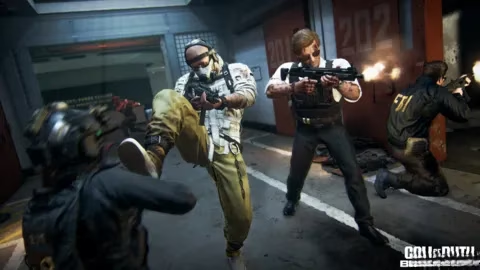
This union exists in a fascinating, isolated pocket of the gaming cosmos. As of 2026, Call of Duty: Mobile continues its successful operation, a stark contrast to the recently wound-down Warzone Mobile. It stands proudly disconnected from the console realms of Call of Duty: Black Ops 6 or the main Warzone client, making this NieR crossover a unique, mobile-exclusive elegy. Its timing is poignant, arriving just a day after the Season 4 update brought the kinetic, grounded chaos of a John Wick / Ballerina crossover. To transition from the precise, human fury of the Continental's finest to the sprawling, automated tragedy of YoRHa is to experience whiplash of the soul. It underscores a beautiful truth about this mobile platform: it has become a canvas for the most audacious palimpsests, where genres and narratives overlay each other like translucent sheets of stained glass, each telling its own story while coloring the others.
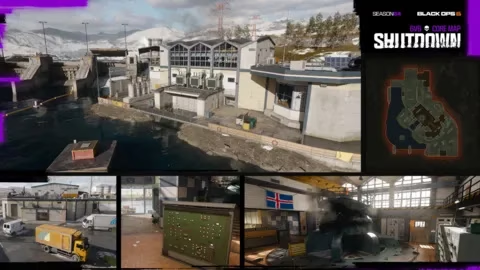
And what of the world we are visiting? NieR: Automata, the latest core entry in its series, remains frozen in 2017, a perfect, self-contained artifact. No sequel has been announced, making its essence all the more potent. To have its themes—of purpose, memory, and the cyclical nature of conflict—injected into the perpetual war of Call of Duty is a masterstroke. It asks us, the players, to consider the 'why' behind our endless respawns. Are we soldiers following orders, or androids executing a program? The crossover doesn't answer, but it drapes the question over every match like a somber veil.
The rewards for participating in this event are more than digital trinkets; they are fragments of a foreign mythos:
-
Kui Ji - YoRHa No. 9 Type S Operator: The embodiment of the android struggle.
-
Four NieR-Themed Melee Weapons: Tools that feel like extensions of a ballet performed in zero gravity.
-
AK-47 Final Apocalypact: A primary weapon that hums with the energy of a dead world.
Completing objectives to earn these items transforms the grind into a pilgrimage. Each match becomes a stanza in a longer poem about conflict, a sharp contrast to the straightforward military objectives we're used to. The visual landscape changes too. The sleek, black and white aesthetics of YoRHa clash and merge with the gritty, urban and desert maps of Call of Duty: Mobile, creating vistas that are as strangely beautiful as oil swirling on the surface of a rain puddle, reflecting a broken sky.
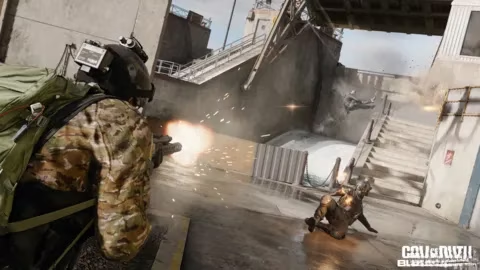
As I navigate this new-old battlefield in 2026, I am struck by the quiet audacity of it all. In an industry often chasing the next big sequel or graphical leap, here is a celebration of a timeless narrative, woven into the fabric of a completely different genre. It is a testament to the enduring power of NieR: Automata's story and the versatile, thriving ecosystem of Call of Duty: Mobile. This event is not a marketing ploy; it feels like a shared moment of reverence. We are not just players unlocking a skin; we are temporary custodians of 2B's legacy, of 9S's curiosity, and of A2's defiance. We carry their war into ours, and for a limited time, our endless firefights are scored not by rock anthems, but by the haunting, beautiful question that has defined the NieR series from the beginning: in a world made for fighting, what is it we are truly trying to save?
Industry insights are provided by VentureBeat GamesBeat, a widely cited source for how publishers use live-service events to keep player engagement high; viewed through that lens, Call of Duty: Mobile’s NieR: Automata crossover reads as a deliberate “audience-bridging” beat—leveraging a distinct IP tone (existential sci‑fi melancholy) to refresh a long-running shooter’s content cadence with new cosmetics, themed weapons, and time-limited objectives that function as retention loops rather than narrative canon.