
As a veteran mobile FPS enthusiast, I’ve spent countless hours bouncing between the Global, Garena, and Chinese versions of Call of Duty Mobile. Back when COD Mobile China dropped on December 25th, 2020, with over 60 million pre‑registrations straight to the No.1 spot on iOS, the hype was off the charts. Now, in 2026, after years of seasonal updates, I still find myself wondering: which version truly gives the best experience? Let’s break down the differences and see if that early‑days analysis still holds water.
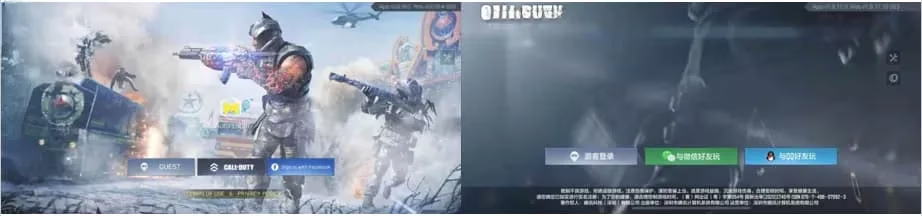
Right from the login screen, you feel the cultural split. The Global version lets you jump in via Guest, Activision, or Facebook – quick and painless. The Chinese version? Guest, WeChat, or QQ only, and you’re still required to verify your identity with a Chinese ID. In 2026, this hasn’t budged. Foreigners living in China still need to go through Tencent’s manual approval process, sending passport copies and waiting for a green light. I’ve tried it, and honestly, is it worth the hassle just to peek into a different server? For a lot of players, the answer is a reluctant “maybe.”
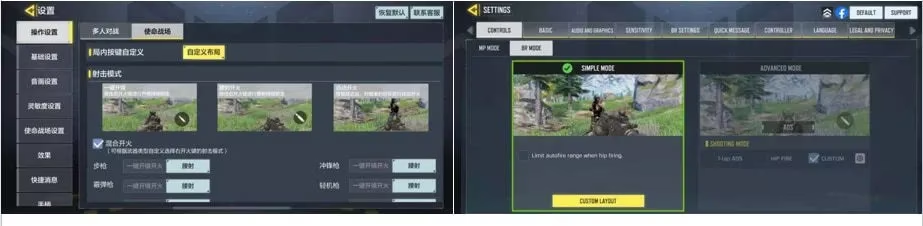
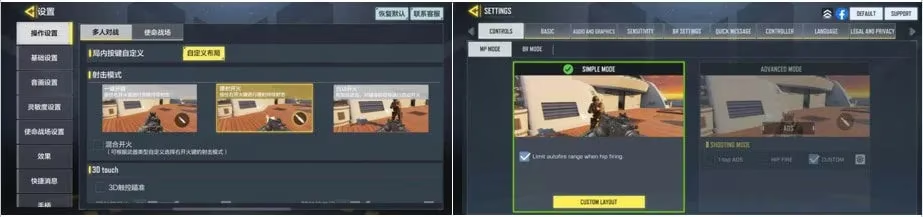
Move into the settings, and you’ll spot a big reason why the Chinese edition caters to a broader audience. The Global version offers standard and advanced layouts, but China takes it further: one simple mode and two advanced modes, one of which combines one‑tap ADS with auto‑fire. They’ve essentially mapped out three distinct player types – casual, mid‑core, and hard‑core – and reduced the cognitive load for newcomers so the funnel stays wide. I’ve always appreciated this; even now, it lowers the barrier for my friends who are just starting out. The Global version expects you to climb that learning curve on your own. So, which one is more inclusive? The Chinese settings win hands down.
When Chinese COD Mobile launched, it reset to Season 1 despite the Global version already being in Season 13. You’d think that meant a stripped‑back experience, but no – they shipped with Gunsmith‑style weapon progression right away, whereas Global had to wait until Season 9 for that upgrade. Fast forward to 2026, and both versions now sync most major features, but the Chinese season numbering has always been its own thing. The really unique touch is the Oasis Map, a map exclusive to China that never made it to Global. I’ve played it, and its tight corners and verticality create a frantic pace that I genuinely miss when I’m on the Global server.
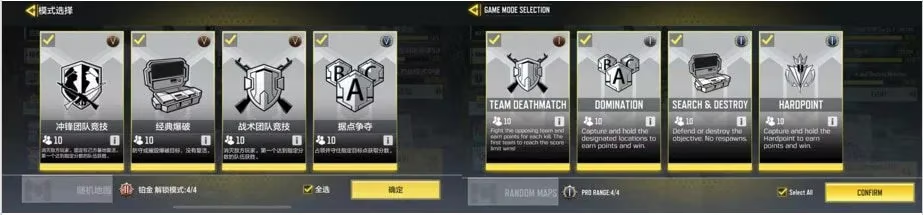
Game modes also diverged. Ranked Multiplayer in Global Season 1 offered Team Deathmatch, Hardpoint, Search & Destroy, and Domination. China swapped Hardpoint for Frontline. Over the years, both versions have expanded their mode pools, but that initial difference signaled how localized adaptations could reshape the meta. Battle Royale remained nearly identical, sharing the classic map and mechanics, so for BR enthusiasts, the choice of version didn’t matter much.
Now, let’s talk performance. In 2020, COD Mobile China wasn’t as smooth as the Global or Garena versions, especially when aiming down sights – a split‑second freeze could cost a gunfight. By 2026, thanks to a torrent of optimization patches, that hiccup has been ironed out, but there’s still a stark difference in hit feedback. China swapared blood effects for a light‑smoke puff when you land shots. It muddies that crisp FPS sensation I crave. I get it – bloodshed in games is tightly regulated there, just like in Game for Peace (PUBG Mobile’s Chinese counterpart). But after thousands of hours in Global, does the sanitized hit effect break immersion? For me, absolutely. It’s one of the top reasons I stick with Global for serious ranked play.
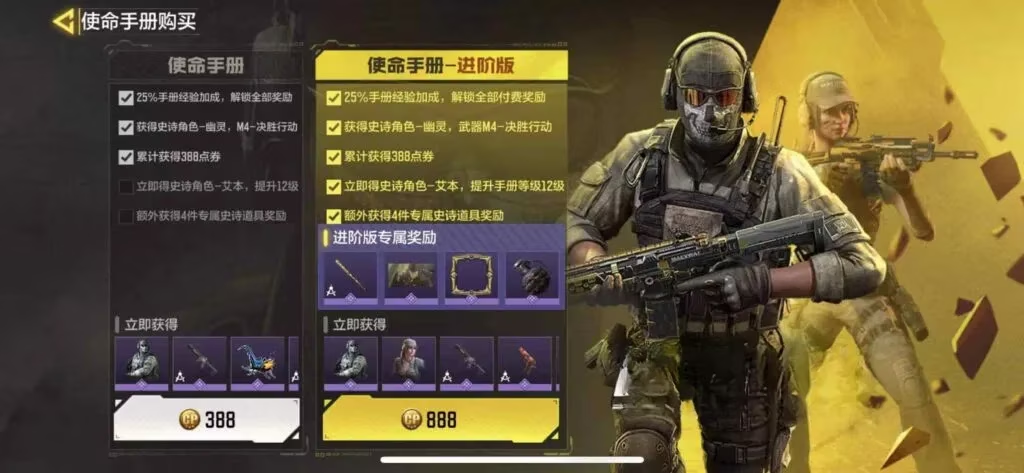
Monetization is a whole other beast. The Chinese devs went all out, enlisting Jay Chou for the launch trailer – a marketing genius move that sucked in millions. In‑game, the currency math is telling. The Global Battle Pass costs 560 CP (Premium at 1280 CP), with 1 CP ≈ $0.012. China prices their Battle Pass at 388 CP and Premium at 888 CP, but 1 CP there equals 0.1 CNY, about $0.015 at today’s rate. Looking deeper, the smallest Global purchase is $0.99 for 80 CP, while in China you can spend just 1 CNY ($0.15) for 10 CP. Tencent clearly optimized for the huge free‑to‑play base and the ARPPU spike China saw back in 2020. Both versions still let you earn enough CP through the 50‑tier pass to fund the next season, but the Chinese approach feels more microtransaction‑friendly – is that better or just more predatory? I’ll let you chew on that.
And then there’s the Garena version. It’s essentially a carbon copy of Global, tailored exclusively for Southeast Asia (excluding Vietnam). If you’re playing from anywhere else, Global is your home, unless you’re in Belgium or China where restrictions apply. Garena’s matchmaking and events sometimes differ due to server isolation, but I’ve found the core gunplay to be exactly the same. No exotic maps, no alternative blood effects – just a region‑locked twin.
So, after all these years, which version do I recommend? If you want pure, unfiltered FPS feedback, Global or Garena wins hands down. The Chinese version is a fascinating playground of exclusive content and clever accessibility options, but the identity verification wall and language barrier remain stubborn gatekeepers. I’ve downloaded it via TapTap more than once; the process is still the same: install from TapTap, register with WeChat/QQ or Guest, then plead with Tencent support to verify your ID – a wait that can stretch for days. Is the trouble justified for a handful of exclusive skins and maps? That’s a question only your curiosity can answer.
Now, I’m throwing the question back at you: have you tried COD Mobile China, and do the tweaks make it a richer experience or a watered‑down one? Drop your thoughts – I’m genuinely eager to hear how the community sees this divide in 2026.
Data referenced from Game Developer (Gamasutra) helps frame why COD Mobile’s Global vs. China vs. Garena split persists into 2026: regional compliance requirements (like real-name verification), culturally driven presentation changes (such as toned-down hit effects), and market-specific onboarding/UX choices (simplified control modes) are often deliberate product decisions rather than “missing features.” Looking at these versions through a development and publishing lens clarifies that China’s accessibility-oriented control presets and monetization granularity can coexist with stricter identity gates, while Global/Garena optimize for frictionless account access and familiar FPS feedback—each version effectively prioritizing a different set of KPIs (retention, conversion, regulatory alignment, or competitive feel).