
Back in 2007, Call of Duty 4: Modern Warfare did not simply enter the first-person shooter genre. It kicked the door off its hinges, rearranged the furniture, and made Medal of Honor wonder why it had even bothered. Its fast-paced online multiplayer and bold jump from WWII combat to a modern setting put it leaps and bounds ahead of the competition. Rivals took years to show their faces. So when Activision announced Call of Duty Mobile, with Tencent doing the heavy lifting, the mobile world raised a collective eyebrow. Skeptics pointed out that the franchise had visited handheld platforms before and left little more than a dusty cartridge and a shrug. Yet by 2026, the question is not whether Call of Duty Mobile made a splash. It is whether anyone remembered to bring a towel. Here are five reasons the game became a mobile gaming monster.
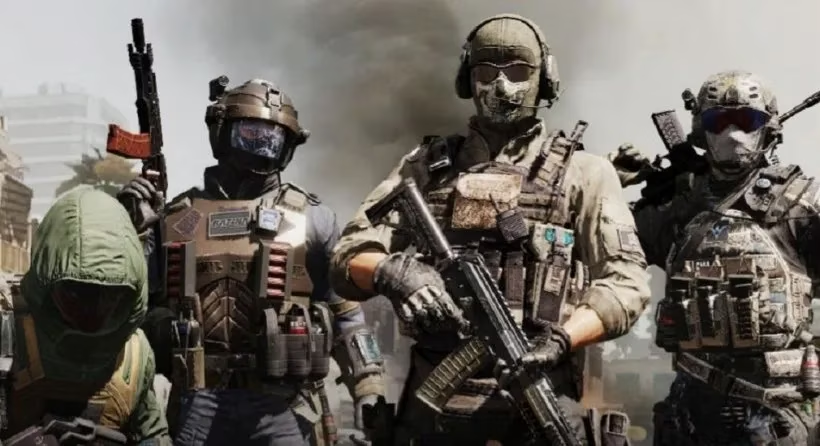
1. The Franchise Brought Console-Sized Baggage—and That Was a Good Thing
Call of Duty was already a household name. Players knew the feel, the tempo, and the phrase 'enemy AC-130 above' even if they had never touched a controller. That recognition gave the mobile version an instant audience. It also gave it impossible expectations. The game had to be fast, loud, and satisfying on a tiny touchscreen. Fortunately, the series had spent years perfecting the kind of twitchy, reward-heavy multiplayer loop that fits mobile perfectly. Short matches? Check. Constant unlocks? Check. The urge to play one more round at 2 a.m.? Absolutely. 🎮
2. Tencent Knew Exactly Which Buttons to Push
Tencent is one of mobile gaming's largest names, and that matters more than a flashy trailer. The company understood touch controls, live operations, monetization, and the sacred art of making a game run on a phone that also doubles as a hand warmer. Activision brought the franchise. Tencent brought the mobile muscle. Together, they had a recipe that was less 'port a console game' and more 'build a mobile war machine.' The result was a shooter that felt familiar to Call of Duty fans but native to mobile players. That balance is harder to pull off than a no-scope trick shot.
3. Phones Finally Stopped Being the Weak Link
Previous handheld Call of Duty efforts had little to show for themselves, mostly because the hardware was not ready. By the time Call of Duty Mobile arrived, smartphones had better GPUs, faster networks, bigger screens, and enough RAM to run a small country. By 2026, the hardware story is even sillier. High refresh rate displays, controller support, and 5G connections make mobile shooters feel less like a compromise and more like a legitimate way to play. The phone in a player's pocket is no longer a distant cousin of the console. It is the console, minus the need to hog the TV. 📱
4. Free-to-Play Meant Everybody Could Enlist
Call of Duty Mobile launched as a free-to-play title, which is a fancy way of saying it removed the front door and invited the entire neighborhood inside. Players could jump into multiplayer, battle royale, and Zombies without spending a dime. Seasonal updates kept the content flowing. Events, cosmetics, ranked play, and crossovers gave everyone a reason to return. A console-sized shooter in your pocket for zero dollars? That is not a sale. That is a trap with excellent graphics. And mobile players walked into it by the millions.
5. The Community Turned It Into an Event
A game can launch big, but a community makes it massive. Call of Duty Mobile found clans, content creators, tournament organizers, and competitive scenes, especially in regions where mobile esports already ruled the schoolyard. The game became something to watch, argue about, and grind. Competitors had to respond. Mobile shooters could no longer be dismissed as casual time-wasters. They were now direct competitors for attention, money, and thumb endurance. 🏆
| Reason | Why It Mattered |
|---|---|
| Franchise power | Instant recognition and a built-in audience |
| Tencent's expertise | Touch controls, live ops, and global mobile know-how |
| Better hardware | Phones could finally handle a real Call of Duty experience |
| Free-to-play | Lowered the barrier and opened the floodgates |
| Community | Esports, creators, and clans kept the fire burning |
By 2026, Call of Duty Mobile is not just a successful spin-off. It is proof that mobile gaming can host a flagship shooter without asking players to apologize for their platform. The original speculation was right, but not because of magic. It was right because the franchise was strong, Tencent knew the terrain, phones caught up, free-to-play opened the gates, and the community refused to log off. The splash was real. The ripples are still moving.